+

The Team

People who know Math.
And how to explain it.

At most centres, the tutor's personality determines the quality. At GPA, the system does. Every tutor is trained to deliver it precisely. What you meet here are the people who built it, and who teach it every day.

100+

Proprietary learning
materials authored in-house

8+

Years refining the
GPA methodology

5+

Branches across
Singapore

+

Founder + Curriculum Architect

Founder & Curriculum Architect
Mrs Eileen Toh, Founder and Curriculum Architect, Genius Plus Academy

Mrs Eileen Toh

Founder of Genius Plus Academy

M.Ed, NIE B.A. (Hons) Education, NIE Former MOE School Teacher Author of 100+ Learning Materials

Mrs Toh's teaching is structured, methodical, and deeply focused on helping students understand the logic behind Mathematics rather than arriving at answers by guesswork. In her class, students quickly learn that the rush to the answer is usually the problem, not the solution.

She founded Genius Plus Academy in 2017 on this belief: that every child can excel in Mathematics when it is explained well. She is also the architect behind GPA's entire curriculum: 100+ proprietary textbooks and workbooks that no other centre has access to. It is a system, built over eight years, encoded into everything taught here.

"First understand the question. Break it down. The moment you get that part right, you're already halfway there."

A framework parents often hear about

One of Mrs Toh's most recognised tools is her Before-Change-After approach to word problems — described using a simple analogy her students never forget:

Before

The top bun. What was the situation at the start?

+

Change

The patty. What actually happened?

+

After

The bottom bun. What is the result?

Once students learn to identify these three parts, complex word problems become far more manageable. It is one of dozens of structured frameworks built into GPA's materials.

A key part of her teaching is training students to read between the lines. She helps them spot hidden clues: time markers like "at first" or "after", constant quantities that never change, and numbers placed deliberately to mislead careless readers.

She is also particular about mathematical presentation. Students are trained to label quantities carefully, distinguish old totals from new ones, and use correct notation when rounding. These habits may seem minor, but in an exam they are often the difference between full marks and unnecessary loss.

"Don't rush. Ask yourself first — what changed, and what did not change?"

Her classroom is warm but disciplined. Students know they can ask questions freely, and they also know they will be challenged to think carefully and work systematically. As a mother of four boys, she understands what parents worry about. She brings that same care to every student.

As featured in

Channel NewsAsia · Mediacorp Channel 5 & 8 · TheAsianParent · AsiaOne · 联合早报 · SingaporeMotherhood · UOB Mother's Day Feature
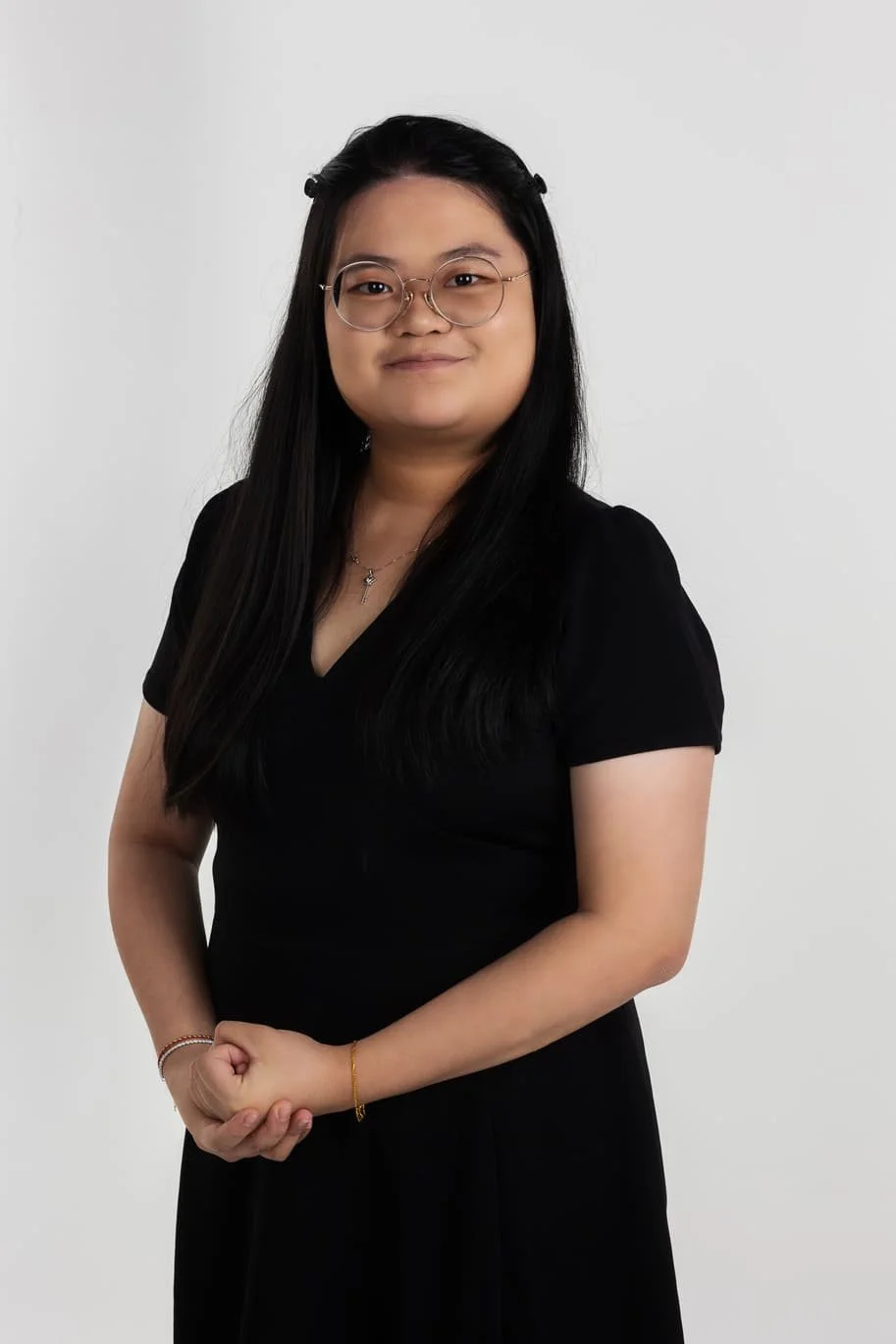
+

Principal Tutor

Ms JS Lee +

Head of Primary Math

B.Sc. (Hons) Head of Primary Math 6+ Years Teaching Experience

Ms Lee's classroom is energetic, interactive, and fast-paced. Lessons move with constant participation: rapid drills, hands-on practice, immediate feedback. Students are rarely sitting quietly for long. They are calculating, answering, checking their work, and improving their speed.

She specialises in building strong procedural fluency. Rather than lengthy theoretical explanations, she focuses on clear, repeatable steps that students can apply confidently under exam conditions. Every method is broken down into specific, manageable actions. Those actions are repeated until they become automatic.

"Quick math. Let's go. Start from the ones place first."

What a Ms Lee method breakdown looks like

  • + Start from the ones place.
  • + Put the carry on top.
  • + Add a zero for the second row.
  • + Write the working clearly, every step.

By repeating these steps regularly, students develop the accuracy and confidence to handle larger calculations without hesitation. The method stays the same; the numbers get harder.

Her teaching also emphasises efficiency: cancelling zeros before dividing, splitting numbers into easier parts, and avoiding unnecessarily large working. Students solve problems faster and make fewer mistakes because they are working smarter, not harder.

Ms Lee is known for her lively teaching style. She keeps students engaged with quick remarks and good-natured humour when mistakes happen, but always follows up immediately with clear guidance on the correction. She is also firm about one thing in particular:

"If I don't see the working, no marks."

She runs live lessons on TikTok that regularly attract large numbers of students attending voluntarily. When a class is that engaging, something is clearly working.

Ms JS Lee, Principal Tutor and Head of Primary Math, Genius Plus Academy
+
Top PSLE Scorer — 281
Ms Arina Rauf, Principal Tutor and HOD, Genius Plus Academy

Head of Publications + Curriculum Specialist

Ms Arina Rauf

Head of Publications & Curriculum Specialist

B.Sc. (Hons) 5+ Years Teaching Experience Top PSLE Scorer in Cohort (281)

Ms Arina is the kind of teacher who makes students feel like they actually know what is going on. Her lessons are calm, structured, and very guided. She does not throw information at students and hope they catch it. She walks them through each concept step by step, constantly helping them connect today's topic to what they have already learned.

"Remember what we did last week? It's the same idea. Just applied in a different way."

That ability to link concepts across chapters is one of her defining strengths. In Mathematics, many students struggle not because they cannot do Math, but because they treat every topic as a brand-new world. Ms Arina teaches them to see patterns, reuse methods, and build confidence by recognising familiar structures in unfamiliar problems.

Her teaching is also notably exam-aware, in a practical way. She highlights key phrases, trains students to pay attention to how questions are worded, and reinforces the specific definitions and method steps that tend to appear in tests.

Small checks Ms Arina uses to keep thinking active

  • + "Do you remember what this is called?"
  • + "Can you identify what the question is asking for?"
  • + "You can highlight this. This wording is important. Later you'll see why."
  • + "Okay — now we compare."

These prompts are not pressure. They are small nudges to keep students actively following the logic rather than passively watching it.

Students who learn with Ms Arina tend to become more organised in their thinking. When something is new, she does not overcomplicate it. She builds it up progressively, starting simple and adding detail only when students are ready.

Particularly well-suited for

Students who need clarity, structure, and connection. Particularly those who feel lost when topics change, or who understand better when ideas are explained in a calm, step-by-step way.

If your child's current experience of Math is "everything feels disconnected," Ms Arina's teaching is often the reset they need.

+

Senior Tutor

Ms Koo +

Primary & Lower Secondary Mathematics

B.Math Sciences (Hons), NTU Primary Mathematics Secondary E Math Teaching since 2017

Ms Koo is the kind of Mathematics tutor who rebuilds a student's foundations properly — patiently, clearly, and without skipping steps. She is particularly effective for students who say things like "I understand it in class, but I keep losing marks," or "I get scared the moment I see fractions." With Ms Koo, those problems become very fixable, because she trains the specific habits that stop students from guessing.

Her most distinctive quality is that she teaches meaning before manipulation. Before a student touches a single step, she makes sure they understand what an expression actually represents. Fractions stop being frightening once a student hears: "Fraction still number right. Same rules apply." That mental reset — anchoring abstract symbols back to familiar ideas — is what makes her especially effective with students who have been confused for a long time.

"Don't have to fear this one. Change it back to numbers first."

The habits Ms Koo builds to stop careless marks being lost

  • + Bring the signs along. A term includes its sign. Moving it without the sign is where most errors begin.
  • + Group like terms correctly. x with x, y with y, constants at the back — in alphabetical order — so nothing gets missed.
  • + Bracket the whole group. If a minus sign applies to more than one term, bracket them. "Bracket is like a house — everything inside belongs together."
  • + Simplify to simplest form. Always. It is expected — and not doing it costs marks even when the working is correct.
  • + Put your units. Kg. Dollars. Minutes. The answer without a unit is an incomplete answer.

One of Ms Koo's most important lessons is knowing when you can cancel and when you cannot. It is one of the most common algebra traps — and she addresses it directly.

The cancelling rule she drills until it sticks

Can cancel

When terms are multiplying — e.g., 3a / 6 simplifies correctly.

Cannot cancel

When terms are adding or subtracting — e.g., (3 + a) / 6 cannot be split.

"Very tempted to cancel — cannot." This is one of the lines her students remember long after the lesson. And that is exactly the point.

She also integrates exam literacy throughout. She trains students to interpret word problems carefully — thinking about direction ("who is heavier?"), about what "twice as heavy" actually means for the calculation, and about drawing a model when the relationship feels unclear. These are not supplementary skills. They are what separate a student who understands the chapter from one who earns full marks on it.

"This is where all the careless happen. Big star for brackets."

Particularly well-suited for

Students who are losing marks not because they lack ability, but because their process is inconsistent. Ms Koo's patient, method-focused teaching rebuilds the habits that turn "I almost had it" into clean, full-mark working — especially in algebra, fractions, and early algebraic manipulation.

K+

Specialises in

  • + Primary Mathematics (P1–P6)
  • + Secondary E Math (G2/O Level)
  • + Eliminating careless errors
  • + Algebra, fractions & signs
  • + Foundations rebuilding

Teaching since 2017

+
C+

Before teaching

  • + Qualified Accountant
  • + Founded her own tuition centre

Teaches

  • + Primary Mathematics (P1–P6)
  • + Interactive, competition-based learning
  • + Structured habit-building for exams

Primary Mathematics Tutor

Ms Cheng +

Former Accountant. Former Tuition Centre Founder.

Primary Mathematics Former Accountant Former Tuition Centre Founder

Ms Cheng brings a background that is almost impossible to find in a Primary Math classroom: she spent years as a practising accountant before founding her own tuition centre. That history is not incidental. It is the reason she teaches the way she does: structured, logical, and extremely disciplined about process.

Step into her class, though, and you will also find something else entirely: it is lively, energetic, and genuinely fun. Her lessons regularly feature friendly competitions, reward systems, and team challenges that keep students focused without feeling like work.

"Eyes on the screen. Focus. Once we start with the ones."

The rules Ms Cheng repeats until they stick

  • + Start with the ones column.
  • + Finish one column before moving left.
  • + Regroup before you subtract.
  • + Cancel properly.

These are not tips. They are mental anchors, repeated consistently until they become instinct. Strong habits, not clever tricks, are what protect students from careless mistakes under exam pressure.

She is also attentive to how each individual student thinks. If one method is causing confusion, she will introduce a different approach without hesitation.

"If this way is too complicated, we try another method."

Presentation is a priority. Ms Cheng pays close attention to working steps and logical flow, because she knows that messy working is usually a symptom of messy thinking. And messy thinking leads to avoidable errors.

"If the working is messy, the thinking becomes messy."

Despite the rigour, her classroom atmosphere stays warm. She celebrates effort, nudges hesitant students to try again, and rarely lets anyone stay stuck for long.

"It's okay — just try. Don't give up so easily."

Particularly well-suited for

Students who need both structure and encouragement. The combination of precise process-building and a warm, competitive classroom makes Ms Cheng's lessons ideal for children who thrive with clear rules, but also need to feel safe enough to make mistakes.

+

Mathematics Tutor

Ms Tan +

Primary, Secondary E Math & A Math

B.B.A. (Hons), University of Hertfordshire 6+ Years Teaching Experience Primary Mathematics Secondary E Math & A Math

Ms Tan's lessons feel less like a lecture and more like a live workshop. They are fast-paced, interactive, and packed with purposeful practice — the kind of session where students leave having done a lot, understood most of it, and felt good about both. She is the tutor who turns revision into momentum.

One of her defining strengths is how well she reads the room. She checks in constantly, using quick progress signals to make sure nobody gets left behind quietly. If a student is stuck, she spots it fast, addresses the exact stumbling block, and reinforces it immediately through targeted questions. In a group setting, her classes manage to feel surprisingly personal.

"Thumbs up so I know I can move on."

How Ms Tan drives the room

  • + Explain the rule or technique briefly and clearly.
  • + Throw a set of questions, starting basic and scaling up.
  • + Watch for signals. Intervene on the exact point of confusion.
  • + Remove the scaffolding. Practice again without support.
  • + Keep going until the steps feel automatic, not effortful.

Her instinct is to build mastery through volume and variation. If a student can handle 25 to 30 different versions of a question type cleanly, the exam version stops being threatening.

Ms Tan is direct about one thing: knowing the chapter is not the same as being ready for the exam. She teaches students to think in question types and trains them to recognise what each command word is actually asking for — not just what to compute, but how the working must be presented to earn the marks.

Exam craft: what Ms Tan drills explicitly

  • + "Show that" questions: work one side, reach the other, write "shown" — not a single shortcut.
  • + "Evaluate": give the final integer. Do not leave the answer in index form.
  • + "Express in terms of…": match the required base exactly.
  • + Substitution questions: recognise the hidden quadratic structure before solving.

Students leave her class with a map of question types, not just a pile of answers. That is what prevents the most common exam mistake: knowing the chapter but losing marks on method and format.

She is also honest about what traps students most. She names the specific habits that cost marks — the assumptions, the skipped steps, the notation errors — and she addresses them directly, without drama, the moment she sees them appear in practice.

"Later I remove the formulas already. In the exam, there are no formulas."

What students respond to most is her personality. She is warm, playful, and genuinely present in her classes — the kind of teacher who makes the room feel energetic without making anyone feel small. She celebrates effort openly, owns her own mistakes without hesitation, and creates an atmosphere where students feel safe to try, get it wrong, correct it, and keep going.

Particularly well-suited for

Students who need both energy and structure. Whether your child is building Primary Math foundations or tackling Secondary E Math and A Math, Ms Tan's workshop-style teaching builds the kind of practice volume and exam awareness that turns "I sort of understand it" into "I can actually do this in a test."

T+

Specialises in

  • + Primary Mathematics (P1–P6)
  • + Secondary E Mathematics (G2/O Level)
  • + Secondary A Mathematics (G3/O Level)
  • + High-volume drill and question variation
  • + Exam craft: command words, presentation, format
  • + Pattern recognition and technique spotting

6+ years teaching experience

+
J+

Specialises in

  • + H1 & H2 Mathematics (JC)
  • + Functions, Graphs & Calculus
  • + Graph intuition & visual frameworks
  • + Checklist systems for mark-saving

Track record

  • + 6+ years teaching experience
  • + 150+ JC students guided
  • + B.Sc. (Hons) Data Science & Analytics, NUS

Head of JC Math

Mr Jeremiah +

Senior Tutor, H1 & H2 Mathematics

B.Sc. (Hons) Data Science, NUS 6+ Years Teaching Experience 150+ JC Students Guided

Mr Jeremiah is a calm, highly structured Mathematics tutor whose defining quality is this: he makes difficult topics feel manageable. Not through shortcuts or false reassurance, but through genuine clarity — breaking complex chapters into clean mental models, then building on them step by step until students can apply them reliably under exam pressure.

His approach is framework-first. Every topic becomes a system: identify the question type, apply the correct test, sketch where needed, follow the steps, then verify. Students who have previously felt overwhelmed by JC Math consistently describe his lessons with the same phrase — "Okay, I can actually do this."

"It might look daunting, but trust me — once you understand the logic, it becomes very systematic."

His standard problem-solving system

  • + Identify the question type first.
  • + Apply the correct test (line tests, domain checks, constraint spotting).
  • + Sketch first — build the geometric picture before the algebra.
  • + Follow the steps. Clarity before speed.
  • + Verify — confirm the working is logically sound, not just computed.

This sequence is not a rough guide. It is the structure he repeats across every topic until it becomes instinct — so that when a student encounters an unfamiliar question, the system still holds.

He is particularly strong at graph- and function-heavy topics, where his visual approach sets him apart. He almost always sketches before solving — building geometric intuition that gives students a way to reason about a problem before the algebra begins. He trains students to use checklist frameworks (covering restrictions, intercepts, turning points, asymptotes) so that key features are never missed, and marks are never dropped unnecessarily.

His lessons are guided and interactive. He checks understanding frequently, asks targeted questions to sharpen reasoning, and adjusts his explanation until the concept genuinely lands. Students feel safe to pause and clarify, because that is explicitly what he invites.

"If at any point you don't understand, stop me."

How he keeps students thinking, not just watching

  • + "What's the test here?"
  • + "What do you have to do next?"
  • + "So far clear? Does that make sense?"
  • + "Think of it as… imagine you shift the line…"

Each check-in keeps students actively following the logic. The effect over time is that students develop the habit of reasoning through a problem, rather than waiting to be shown the answer.

Particularly well-suited for

JC students who feel that H2 Math is too abstract or too fast-paced to follow. Mr Jeremiah's structured, visual, framework-driven approach gives students a reliable system to fall back on — especially when topics feel overwhelming or when exam pressure sets in.

+

Next Step

Ready to meet the team in person?

A trial lesson is the best introduction. Your child gets to experience the method. You get to see the difference.

Book a Trial Lesson